
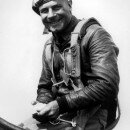
May 25th, 1927
Lieutenant James Doolittle was the first pilot to successfully perform an outside loop. Flying a Curtiss P-1B Hawk, he began the manoeuvre in level flight at 10,000 feet, then pushed the nose down into a dive.
Read More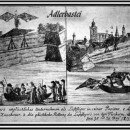
31st May, 1811
He attempted his first flight, in the presence of the king’s three sons and the crown prince of Bavaria, on May 31st 1811. Berblinger waited so long for a good wind, that a policemen finally gave him a push and Berblinger fell into the Danube.
Read More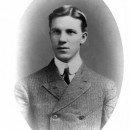
May 14th, 1908
On the 14th May 1908, the trusting Charles Furnas became the first passenger in an aeroplane, piloted by Wilbur Wright.
Read More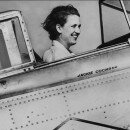
18th May, 1953
On May 18th, 1953 aviatrix Jacqueline Cochran became the first woman to pilot an aircraft supersonically. She broke the sound barrier, travelling 1006.6 kilometres miles per hour, in an F-86 Sabre.
Read More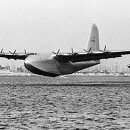
2nd November, 1947
On 2nd November, 1947, Howard Hughes made the first and only flight in the Hughes Aircraft Company H-4 Hercules flying boat, NX37602 - the infamous 'Spruce Goose' - at the harbour of Los Angeles, California.
Read More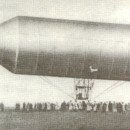
November 3rd, 1897
On the 3rd November 1897 Ernst Jagels on behalf of the Prussian Airship Battalion made a test flight in an all-aluminium craft designed by the recently deceased Austro-Hungarian engineer David Schwarz and built by Carl Berg. This was the first flight in a rigid airship, reaching an altitude of 24 metres, proving metal-framed airships can become airborne.
Read More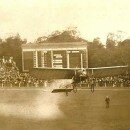
November 15th, 1910
In 1910 pioneering aircraft manufacturer Louis Bleriot sent Gaston Cugnet to Australia in the hopes of founding a permanent aviation business in Australia. On November 5th at Altona in Melbourne, Cugnet undertook his first flight but ‘struck a cow’ upon landing. Ten days later he successfully achieved a height of 200 feet for a duration of seven minutes.
Read More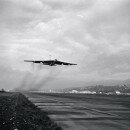
October 2nd, 1952
The Boeing XB-52 Stratofortress prototype, 49-230, made its first flight at Boeing Field, Seattle, Washington, with test pilot Alvin M. “Tex” Johnston in command.
Read More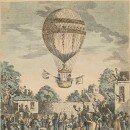
4th October, 1784
James Sadler becomes the first British aeronaut, piloting a balloon six miles from Christ Church Meadow, Oxford to Woodeaton, reaching an altitude of 3,600 feet.
Read More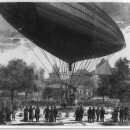
8th October, 1883
The first airship powered by an electric motor was flown by seasoned aeronautical brothers Albert Tissandier (1839–1906) and Gaston Tissandier (1843–1899) at at Auteuil, a suburb of Paris, France.
Read More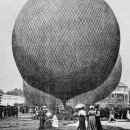
9th October, 1900
In October, 1900, French aeronaut Count Henri de La Vaulx set a world record for non-stop long-distance balloon flight, flying over 35 hours after taking off from Paris.
Read More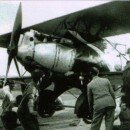
October 14th, 1927
On October 14th, 1927 Dieudonne Costes and Joseph le Brix set off on the first successful non-stop aerial crossing of the South Atlantic, flying a Breguet 19GR from Saint-Louis, Senegal to Port Natal in Brazil, as a part of their 57,000-km round-the-world trip.
Read More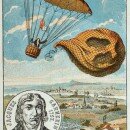
22nd October, 1797
André-Jacques Garnerin, balloonist and inventor of the frameless parachute, jumped from a balloon on October 22nd, 1797 from 975 metres over in Paris in a 7 metre diametre parachute made of white canvas with a basket attached. This was the first ever jump with a silk parachute.
Read More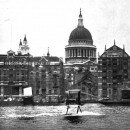
August 10th, 1912
On the 10th August 1912, Frank McLean flew his modified Short S33 flying boat, along the Thames River in London, "creating a record by flying up the Thames in a seaplane, passing between the upper and lower parts of Tower Bridge and under London Bridge without touching the water." Sir Francis was a civil engineer, astronomer, pioneering photographer and aviator. He received the Royal Aero Club’s Aviator Certificate Number 21 on 20th September 1910. He served in the Royal Naval Air Service during World War I and became an officer of the Royal Air Force when RNAS and the Royal Flying Corps were combined. McClean is considered the founder of the Fleet Air Arm.
Read More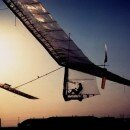
August 23rd, 1977
Amateur cyclist and hang-glider pilot Bryan Allen piloted the 'Gossamer Condor', the first human-powered aircraft capable of controlled and sustained flight, over a 1.6kms course in California to take the $50,000 Kremer prize in 1977.
Read More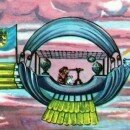
August 8th, 1709
On August 8th 1709, Father Bartolomeu de Gusmão, a Brazilian priest, demonstrated a practical model of a hot-air balloon made of a paper envelope with burning material suspended below it to King John V of Portugal in the Ambassador's drawing room. This first ever demonstration of a practical lighter-than-air craft was curtailed by a gaggle of servants who snatched the balloon out of the air for fear it would set fire to the curtains.
Read More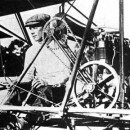
16th July, 1910
On July 16th 1910, the first powered controlled flight of an Australian designed and constructed aeroplane took place near Kyneton in Victoria. John Robertson Duigan flew his aircraft for the grand distance of 23 feet at his family's property 'Spring Plains' at Mia Mia. The flight was all the more remarkable for the fact that Duigan achieved it with little outside help other than a few magazine articles and the engineering skills of his brother Reginald.
Read More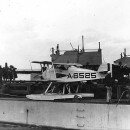
July 26th, 1926
During United States Navy experiments with the operation of seaplanes from a submarine equipped with an aircraft hangar, the submarine USS S-1 (SS-105) carries out for the first time, on July 26th 1926, a full cycle of surfacing, removing the disassembled seaplane from its hangar, assembling it, launching it, retrieving it, disassembling it, stowing in its hangar and submerging, on the Thames River at New London, Connecticut.
Read MoreJune 1928
At the start of June, 1928, Kingsford Smith, co-pilot Charles Ulm, navigator Harry Lyon and radio operator James Warner set off from San...
Read MoreJune 1897
On the 11th June, 1897 Salomon Andrée, N. Strindberg and K. Fraenkel attempted an Arctic expedition to the North Pole by hydrogen...
Read MoreLatest Issue Out Now
Newsletter Subscribe
Recent News


Words of Wisdom
 Loading
-
-

“Nobody who has not been up in the sky on a glorious morning can possibly imagine the way a pilot feels in free heaven.”
-


